Hume Health Review 2026: The Wearable That Tracks How You Age, Not Just How You Move

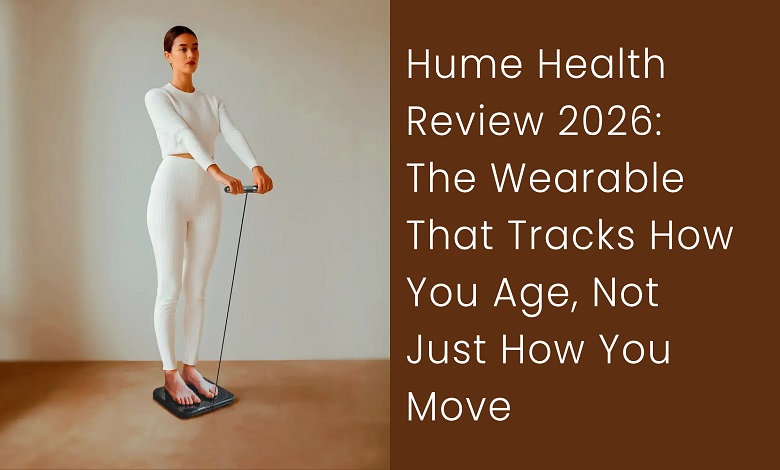
Description: Is Hume Health worth it? Read our in-depth 2026 review of the Hume Band 2.0 and Body Pod—covering metabolic capacity, longevity tracking, accuracy, and whether it beats Whoop and Oura.


Introduction: What If Your Wearable Could Tell You How Fast You’re Aging?
I remember the exact moment I realized my fitness tracker was lying to me.
I had just finished a brutal workout—sweat dripping, muscles screaming, heart pounding. My tracker proudly displayed: “Great job! 10,000 steps achieved!”
Ten thousand steps. That was its grand verdict on two hours of intense physical exertion.
Not heart rate variability. Not recovery quality. Not whether my body was actually benefiting from all that effort or slowly breaking down.
Just… steps.
That was the moment I started looking for something more. Something that would tell me not just how much I moved, but how well my body was handling the stress I was putting it through.
Enter Hume Health—a company that’s quietly building what might be the most interesting health tracking ecosystem on the market today.
Unlike the Apple Watches and Fitbits of the world, Hume Health doesn’t care about your step count. It cares about your metabolic capacity. It doesn’t obsess over your daily activity—it obsesses over how your body recovers from that activity. And instead of telling you how many calories you burned, it tells you whether you’re aging faster or slower than you should be.
Intrigued? You should be.
Here’s everything you need to know about Hume Health in 2026—the good, the bad, and the genuinely revolutionary.

What Is Hume Health?
At its core, Hume Health is a health technology company with a simple but ambitious mission: to help people understand what’s happening inside their bodies, not just on the surface.
Founded in 2023 and co-founded by Jeffrey Lee, Hume Health was built on the belief that healthcare should be proactive, accessible, and built around real insight. The company recognized that most people only see fragmented snapshots of their health—a doctor’s visit here, a blood test there. Their goal was to create tools that translate complex clinical data into guidance anyone can understand.
Today, Hume Health offers two primary products:
- Hume Band 2.0 — A screenless wrist-worn wearable that tracks over a dozen biometric signals 24/7
- Hume Health Body Pod — A smart body composition scale that measures 45+ health metrics from the comfort of your bathroom
Together, they form what the company calls a “longevity ecosystem”—a way to continuously monitor, understand, and optimize your health over years and decades, not just days and weeks.
The Hume Band 2.0: Your Wrist’s New Best Friend
What Makes It Different?
The Hume Band 2.0 is the company’s flagship wearable—and it’s unlike anything else on the market.
First, there’s no screen. No notifications. No distractions. It’s just a comfortable fabric band that wraps around your wrist and quietly does its job.
Second, it tracks metrics that most wearables ignore entirely:
- Heart Rate Variability (HRV) — A key indicator of stress and recovery
- Blood oxygen (SpO₂) — Essential for understanding sleep quality and respiratory health
- Skin temperature — Continuous monitoring that can detect early signs of illness
- Blood pressure trends — New to the 2.0 version, offering insights into cardiovascular health
- Sleep stages — Light, deep, and REM sleep analysis
- Recovery status — How well your body is bouncing back from stress
But the real magic lies in two proprietary metrics that Hume Health has developed: Metabolic Capacity and Metabolic Momentum.
Understanding Metabolic Capacity
Think of Metabolic Capacity as your body’s battery—but not just the size of the battery, how efficiently it charges and how long it lasts.
According to Hume Health, Metabolic Capacity is “your body’s ability to generate, store, and use energy efficiently—whether you’re moving, thinking, recovering, or resting”. A higher capacity doesn’t just mean you can run further; it means your system is robust enough to handle the wear and tear of aging.
In other words, it shifts the focus from “how much did I do today?” to “how well is my body handling the load?”
Understanding Metabolic Momentum
If Metabolic Capacity is your battery, Metabolic Momentum is the speedometer for your aging process.
It analyzes your daily inputs—sleep, movement, stress—to determine whether your current lifestyle choices are accelerating the aging process or hitting the brakes. This is where the “coach” aspect comes in, allowing you to make micro-adjustments that ensure your trajectory is pointed toward a longer, stronger life.
One reviewer put it perfectly: “If Whoop is for the athlete trying to peak for a race, and Oura is for the biohacker trying to optimize sleep, Hume is for the person trying to slow down aging”.
The Hume Health Body Pod: More Than Just a Scale
45+ Metrics in One Step
If the Hume Band is your 24/7 health monitor, the Body Pod is your weekly check-in.
This isn’t your average bathroom scale. The Body Pod uses bioelectrical impedance analysis (BIA) with multi-frequency sensors to measure 45+ body composition metrics. These include:
- Body fat percentage — Not just total fat, but distribution
- Muscle mass — Track gains and prevent loss
- Visceral fat — The dangerous fat around your organs
- Bone mass — Essential for aging well
- Total body water — Hydration status
- Metabolic age — How your body compares to others your age
- Protein levels — Key for muscle maintenance
Clinical-Grade Accuracy
The Body Pod has been described as “what happens when you take a hospital-grade diagnostic machine and shrink it down for home use”. With a claimed accuracy of 98% compared to DEXA scans—the gold standard for body composition analysis—it’s one of the most accurate at-home body composition devices available.
It’s also the only scale approved for use in medical clinics, according to the company.
Price and Value
At **$229**, the Body Pod sits at a sweet spot—cheaper than the $379 InBody Dial H30 and significantly less than the $499 Withings Body Scan. Yet it tracks more metrics than both competitors.

Hume Health vs. The Competition
Hume Band 2.0 vs. Whoop
The verdict? Whoop is the stronger device for training, with better strain and recovery systems. The Hume Band 2.0 is the better long-term health buy, with longevity and metabolic tracking, blood pressure trends, and no subscription .
Hume Band 2.0 vs. Oura Ring
Oura Ring 4 starts at $399 and also requires a subscription for full functionality. The Hume Band 2.0 offers comparable health tracking—including HRV, sleep, and recovery—without the subscription requirement and at a significantly lower price point.
Hume Body Pod vs. Withings Body Scan
The Body Pod focuses on body composition tracking, AI-powered health insights, and fitness-oriented coaching at a significantly lower price point.
The Hume Health App: Where Data Becomes Insight
Both the Hume Band and Body Pod feed data into the Hume Health app—and this is where the real value lies.
The app doesn’t just display numbers; it uses AI-powered algorithms to transform raw biometric data into personalized recommendations. You can:
- Track long-term health trends — See how your metrics change over months and years
- Monitor recovery and readiness — Know when to push and when to rest
- View biological aging metrics — Understand your Pace of Aging
- Get personalized recommendations — Actionable insights, not just data
- Sync with Apple Health and Google Health — Keep all your health data in one place
One user noted: “The Hume Band and Pod has been great tracking my data along my health journey… Sleep performance seems accurate”. Another added: “It’s been great to identify hydration levels and I’ve made progress in a matter of days by drinking more water”.
The Truth About Accuracy: What Independent Testing Shows
Body Pod Accuracy
Independent reviews suggest the Body Pod’s accuracy is impressive but not perfect. One reviewer noted that “the lean mass readings by Hume tended to slightly over-estimate compared to DEXA, while fat mass/fat percentage sometimes under-estimated”.
However, for most users, the Body Pod “offers the best combination of accuracy, usability, and value”.
Band Accuracy
The Hume Band uses 5 LEDs and 4 photodiodes—more than most competitors—to capture health data. One reviewer who wore the band alongside an Oura Ring 4 and Garmin chest strap found it provided “strong trend-based coaching” and was “super comfortable”.
However, like all wrist-based optical sensors, it can lag during high-intensity exercise and may under-read heart rate peaks.
Real User Experiences: The Good, The Bad, and The Honest
The Good
- “Learning more about your body and health is exciting rather than just counting steps” — Trustpilot reviewer
- “Very user friendly and gives insight into every metric it follows” — App Store reviewer
- “We both absolutely love this scale and the amount of data it provides” — App Store reviewer
- “Looking forward to seeing my body numbers change as I lose weight and gain muscle” — App Store reviewer
The Bad
- Battery life on the original band fell short of claims — one reviewer reported the battery “consistently fell short of the advertised 4-5 days”
- Bluetooth connectivity issues — some users reported disconnections
- Customer support can be slow — “They seem to be understaffed or overwhelmed”
- Setup can be confusing — one user reported wasting an hour trying to connect the device
The Bottom Line
Hume Health has a 3.8/5 rating on Trustpilot. The overwhelming majority of users find the products valuable, but the company clearly has room for improvement in customer support and product reliability.
Is Hume Health Worth It in 2026?
Here’s the honest answer: it depends on what you’re looking for.
Buy Hume Health if:
- You’re tired of step-counting and want deeper health insights
- You care about longevity and want to understand how your lifestyle affects aging
- You want a subscription-free alternative to Whoop
- You value body composition tracking beyond just weight
- You’re willing to tolerate occasional tech quirks for the data
Skip Hume Health if:
- You need a smartwatch with notifications and apps
- You want the most athlete-optimized recovery platform (get Whoop instead)
- You’re not interested in tracking your health long-term
- You’re easily frustrated by Bluetooth connectivity issues
Key Insights: What You Need to Remember
- Hume Health focuses on longevity, not fitness — It tracks how your body ages, not just how it moves
- Metabolic Capacity and Metabolic Momentum are game-changers — These proprietary metrics help you understand your body’s resilience and aging trajectory
- No mandatory subscription — Unlike Whoop and Oura, Hume Health doesn’t lock basic data behind a paywall
- The Body Pod tracks 45+ metrics — Making it one of the most comprehensive at-home body composition devices available
- Accuracy is strong but not perfect — The Body Pod claims 98% accuracy compared to DEXA, but some users report slight variations
- The ecosystem approach works — Using both the Band and Body Pod together gives you a complete picture of your health
- Customer support needs work — Some users report slow response times and connectivity issues
FAQ: Everything You’ve Been Wondering About Hume Health
What does Hume Health track?
Hume Health tracks a comprehensive range of biometrics including heart rate, heart rate variability (HRV), blood oxygen (SpO₂), skin temperature, sleep stages, recovery status, blood pressure trends, and body composition metrics like body fat percentage, muscle mass, and visceral fat.
Is Hume Health better than Whoop?
It depends on your goals. Whoop is stronger for athletic performance tracking with better strain and recovery systems. Hume Health is better for long-term health and longevity tracking, with metabolic insights, blood pressure trends, and no subscription requirement.
Does Hume Health require a subscription?
No. The basic Hume Health app and all core metrics are available without a subscription. There is an optional premium plan for $8.99/month that offers deeper health insights.
Is the Hume Health Body Pod accurate?
The Body Pod claims 98% accuracy compared to DEXA scans, the gold standard for body composition analysis. Independent reviews suggest it offers “the best combination of accuracy, usability, and value” for most users, though some have noted slight variations in lean mass and fat percentage readings.
How long does the Hume Band battery last?
The Hume Band 2.0 offers up to 14 days of battery life with its upgraded sensors. The original Hume Band offered up to 5 days, though some users reported it fell short of this claim.
Is Hume Health HSA/FSA eligible?
Yes, both the Hume Band and Body Pod are HSA and FSA eligible.
Can I use Hume Health without a smartphone?
No, the Hume Health app is required to view your data and insights. Both the Band and Body Pod sync via Bluetooth to your smartphone.
What’s the difference between Hume Band 1.0 and 2.0?
The Hume Band 2.0 adds blood pressure trend monitoring, continuous skin temperature tracking, an enhanced sensor system with 5 LEDs and 4 photodiodes, improved IP68 water resistance, up to 14 days of battery life, and a more comfortable UltraLux strap.
Final Verdict: Should You Buy Hume Health in 2026?
Here’s the truth: most wearables are still asking the wrong questions.
They ask: “How many steps did you take?” “How many calories did you burn?” “How many hours did you sleep?”
Hume Health asks something different: “Is your body getting stronger or weaker?” “Are you aging faster or slower than you should be?” “How well are you really recovering from the stress of daily life?”
Those are the questions that actually matter for long-term health. And for that reason alone, Hume Health deserves your attention.
Is it perfect? No. The battery life on the original band was disappointing, Bluetooth connectivity can be finicky, and customer support could be better.
But for $218—less than a year of Whoop subscription—you get a device that tracks what actually matters for your long-term health. And if you pair it with the $229 Body Pod, you get one of the most comprehensive at-home health tracking systems available at any price.
If you’re ready to stop counting steps and start understanding your body’s true trajectory, Hume Health might just be the wearable you’ve been waiting for.